
Article
What Nobody Tells You When You're Looking for Office Space in Melbourne

Finding a desk is easy. Finding the right office is the part that tends to catch businesses out.
Melbourne's CBD has no shortage of options. Flexible providers have multiplied, vacancy has kept supply visible, and the market looks, from the outside, like a buyer's one. In practice, the businesses that get this decision right and the ones that regret it tend to have made different versions of the same mistake: they optimised for the wrong thing.
Here is what actually matters.
Start With the Building, Not the Brochure
Most office searches begin with size and price. The building tends to be treated as a backdrop. That is usually the first error.
A lobby that feels tired sends a message to every client who walks through it. Natural light and air quality bear directly on how people feel about spending eight or nine hours inside a space. End-of-trip facilities that are genuinely good versus nominally present make a real difference to whether staff choose to commute. None of these things appear in a lease summary, and none of them are obvious from a website.
Melbourne's CBD has considerable variation in building quality that does not map neatly onto location or price. Some well-situated buildings have aged less gracefully than their addresses suggest. The practical advice is straightforward: visit in person, more than once, at different times of day. The building that looked promising in a Monday morning tour can feel quite different on a wet Thursday afternoon when the lifts are slow and the lobby is crowded.
The Real Cost of a Conventional Lease
For a team under thirty people, a direct lease in Melbourne tends to look attractive until it is properly priced. The headline rate per square metre is only the beginning. Add the fit-out, which for a professional environment can run to several hundred dollars per square metre. Add legal costs on both sides of the negotiation, furniture, IT infrastructure, reception coverage, cleaning, building outgoings, and the internal management time required to coordinate everything. Then add the three to six months during which the space is being built while rent is already running.
By the time that accounting is done, the option that looked more expensive per desk rarely is. For businesses with any uncertainty in their headcount over the next two years, which describes most of them, the flexibility built into a licence agreement has additional financial value that a desk-rate comparison will never capture.
Flexibility Means Something Specific
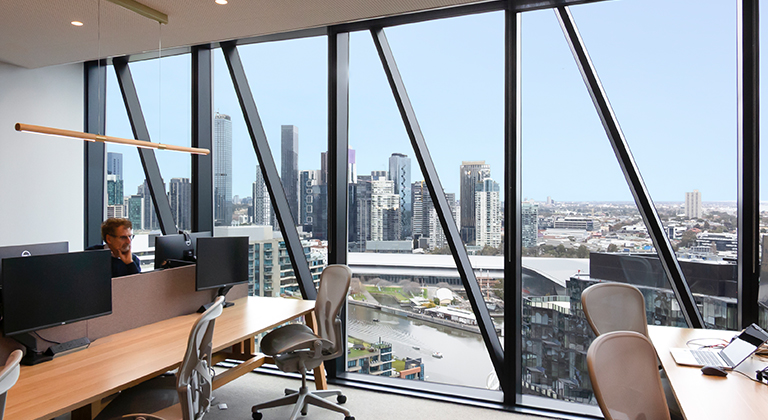
The word gets used loosely in office marketing. What it should mean in practice: the ability to take more space in the same building as a team grows, without a new lease negotiation. The ability to scale back if circumstances change, without a dilapidations claim. Meeting room capacity available on demand rather than built speculatively into a fit-out. Licence structures that do not require betting the property position on a three-year headcount forecast.
That kind of flexibility has become genuinely valuable in a market still calibrating how much space hybrid working actually requires. The businesses that locked into large conventional leases a few years ago on the assumption that full attendance would return are managing the consequences. The ones that kept their options open are not.
Speed Is a Strategic Variable, Not an Administrative One
For firms entering Melbourne from interstate or overseas, time is often the most underweighted factor in the whole decision. A conventional lease, from heads of agreement to a functioning workplace, typically consumes three to six months. That gap has real consequences: senior hires who expect a credible office on arrival make different decisions when they find a half-finished fit-out; deal momentum that exists in one quarter can be gone before the space is ready.
A good office space can be operational within days. Connectivity is already in place, meeting rooms are bookable immediately, reception handles visitors as if the business has been there for years. For a company that needs to appear settled before it is fully scaled, that is not a convenience. It is a meaningful competitive advantage.
Service Is Infrastructure, Not Hospitality
One of the less obvious advantages of a serviced office is what it removes from the management agenda permanently. Reception, IT support, meeting room logistics, visitor handling, mail, cleaning, facilities maintenance: in a conventional lease these are all problems the business owns. In a well-run serviced office they are handled, reliably, by someone else.
For a small or mid-sized team this is not trivial. The hours a senior person spends managing a building relationship, chasing a contractor or troubleshooting connectivity on the morning of an important meeting are hours not spent on the business. The compounding effect of that over twelve or twenty-four months is significant even when it is hard to quantify precisely.
This is the part of the decision that separates operators who run a genuinely good private office from those who offer a furnished room with a shared kitchen. The question to ask on any tour is not what the space looks like. It is what happens when something goes wrong, and who exactly deals with it.
What Good Looks Like in Practice
The Executive Centre's workspaces at Collins Square and Collins Place occupy two of Melbourne's most in-demand business addresses, and the spaces inside them are designed to match.
Collins Square anchors the western edge of the CBD, where a dense concentration of legal, technology and enterprise firms has made it one of the city's most active commercial precincts. Collins Place sits in the established eastern core, familiar to the senior corporate and financial community that has gravitated there for decades. Both buildings are premium grade, well-maintained, and carry the kind of address recognition that quietly shapes how clients and candidates perceive the businesses inside them.
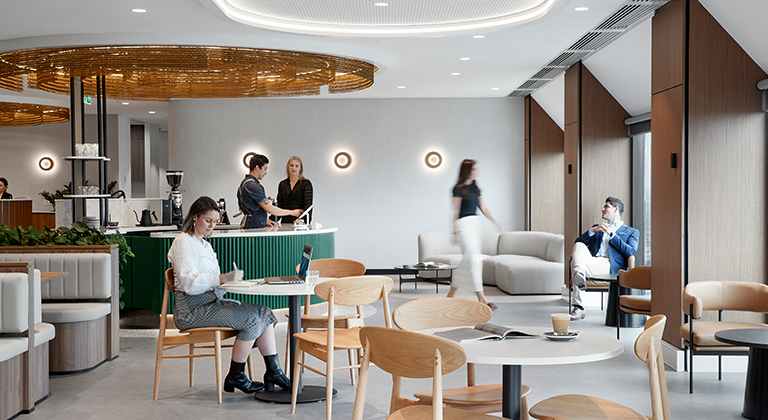
The offices themselves are fitted out with ergonomic furnishings, considered layouts and the kind of design detail that makes a space genuinely comfortable to work in across a long day rather than merely presentable for a tour. Fully equipped Boardrooms and Meeting Rooms are available on demand. Amenities are calibrated for professional use: reliable, well-stocked and maintained to a consistent standard rather than left to drift after the initial impression.
The service layer is what ties it together. Dedicated on-site teams handle the building relationship so the companies inside do not have to. Reception staff know the business by name, recognise returning clients, and manage first impressions with a consistency that a busy executive cannot always guarantee personally. Enterprise-grade connectivity comes with IT support on call. And for businesses that grow, additional Private Offices within the same building are available without re-entering the property market.
The licence structures are built for companies navigating genuine uncertainty. A business can arrive with a team of six, expand into more space as it scales, and adjust along the way without the friction that conventional leasing builds into every change. The address, the design, the service and the flexibility sit together as a single proposition rather than separate line items to be traded off against each other.
The Question Worth Asking Honestly
A well-chosen office in Melbourne should do several things at once: put the business in a building its clients and candidates respect, allow it to operate immediately, give it room to move as circumstances change, and remove the operational overhead that would otherwise sit on someone's plate indefinitely.
The businesses that get this right tend to be the ones that look past the initial rate comparison, visit more buildings than they think they need to, and ask specific questions about what daily life inside the office actually involves. The coffee machine is easy to assess. The service model underneath it requires more attention, and it is almost always where the real difference lies.
Experience the difference for yourself. Book your tour of The Executive Centre at Collins Square or Collins Place.


