
Article
Temporary Offices in Hong Kong: A Practical Guide for Businesses in Transition

The Gap Nobody Budgets For
Every office relocation has a plan. What it rarely has is an honest accounting of the interval, the weeks or months between lease end and new occupation when the business is, in practice, operating without a proper base.
That interval used to be an inconvenience. In Hong Kong's current market, where Grade A vacancy sits at 13.5 per cent but the overwhelming majority of available stock is neither fitted nor immediately occupiable, it has become a strategic problem. Space exists. Usable space, on short terms, at a credible address, ready from day one, is a different and much narrower category.
The organisations that handle transitions well tend to have recognised this distinction early. Those that don't usually discover it around week three, when the improvisation that seemed manageable starts to compound.
What the Vacancy Rate Actually Tells You
A 13.5 per cent vacancy rate implies a buyer's market. For most occupiers in transition, it is more complicated than that.
Vacancy figures capture space that is available in principle. They do not distinguish between fitted and shell condition, between landlords willing to offer short-term arrangements and those holding out for five-year commitments, or between buildings that carry the kind of address that matters to a client and those that merely have square footage. For a business that needs to be operational within two weeks, in a meeting-ready private office, at an address in Central or Admiralty, the effective available market is a fraction of what the headline number suggests.
This is not a criticism of the market. It is a structural reality that affects how transitions should be planned. The organisations that treat the headline vacancy figure as a signal of easy availability tend to be the ones making rushed decisions under pressure, and rushed office decisions have a habit of compounding over the length of whatever lease gets signed.
Why the Sequence of Decisions Matters More Than the Decisions Themselves
The most expensive mistake in an office transition is usually not signing the wrong long-term lease. It is signing the right long-term lease at the wrong moment, before the business has settled enough to know what it actually needs.
Headcount assumptions that seemed reliable six months ago shift during restructuring. Teams that were expected to consolidate don't. Hybrid working patterns that looked stable turn out to be negotiable. The organisation that locks in 8,000 square feet in October because prices were attractive frequently finds itself either over-committed or back in the market within eighteen months.
Temporary offices, specifically serviced private offices with flexible terms, solve this not by being cheaper than direct leases, but by buying the one thing that direct leases cannot: time to let requirements crystallise. The business continues to operate professionally. Client-facing activities are uninterrupted. And the decision about permanent space gets made with actual data rather than optimistic projections.
That sequencing discipline, stabilise first, commit second, is what separates organisations that handle transitions cleanly from those that treat every office decision as an emergency.
The Signals a Temporary Office Sends (and What They Cost If Ignored)
Senior executives sometimes treat interim office quality as an internal matter, a temporary inconvenience that clients will understand if explained. In practice, clients rarely need to understand it. They simply observe it and draw their own conclusions.
A professional services firm advising on a transaction, a family office hosting counterparties, a financial institution maintaining regulatory relationships: in each case, the physical environment is part of the implicit case being made about institutional solidity. This is not superficial. It reflects a reasonable inference, that an organisation unable to maintain its own operating environment during a period of change may face similar difficulty managing complexity on behalf of others.
CBRE's occupier research has repeatedly documented a "flight to quality" dynamic across Asia Pacific markets, even among tenants actively reducing their total footprint. The pattern is consistent: companies cut excess space while protecting, sometimes upgrading, the space that carries client-facing weight. The implication for transitions is direct. The cost of a credible temporary office is not just rent. It is the alternative.
What to Actually Look For
The practical criteria for a temporary office in Hong Kong reduce to three questions, in order of importance.
First: can the business operate without explanation? A space that requires caveats, the meeting room isn't quite right, the connectivity is being sorted, the address is a little unusual, is already costing more than its rent. The value of a functional temporary office is precisely that it removes operational overhead during a period when management attention is already stretched.
Second: does the term structure match the actual uncertainty? The appeal of a slightly cheaper direct short-let can evaporate quickly if circumstances change and the exit is costly or complicated. Serviced offices with genuine flexibility, not flexibility in principle but in the actual contract, are worth the premium specifically because transitions have a habit of taking longer and changing shape more than anyone initially plans.
Third: is the location solving the right problem? This is more granular than district prestige. The right question is not which address sounds most impressive, but which one reduces friction for the specific activities the business needs to protect during the transition. A team whose work is concentrated in institutional finance has different proximity needs than a regional headquarters managing internal operations, and the temporary office should reflect that rather than default to the most obvious choice.
The Measure of a Good Transition
The sign that a temporary office has done its job is largely negative: nothing needed to be explained, nothing caused a client to pause, no operational decision was distorted by the constraints of the space. The transition happened, but it happened without leaking into the parts of the business that were supposed to keep running normally.
That outcome requires more deliberate planning than most organisations give it. But it is reliably achievable, and in a market where options are abundant but immediately usable offices on genuinely flexible terms are not, the planning is mostly a matter of starting early enough to choose well.
Work With The Executive Centre
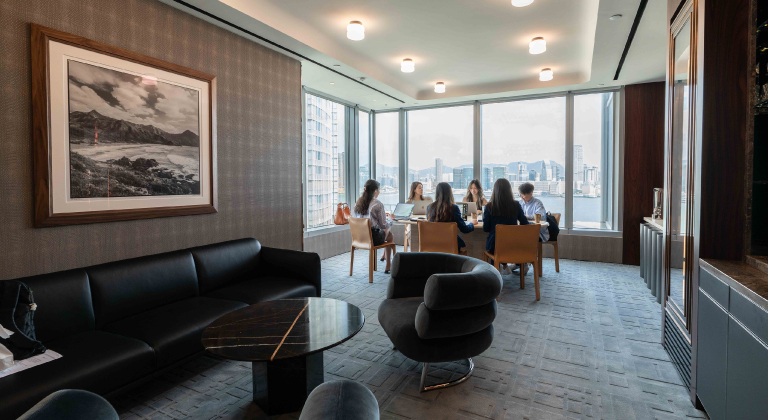
For organisations navigating lease expiries, fit-out delays, or restructuring timelines, The Executive Centre offers fully serviced Private Offices across Hong Kong's key business districts, available on flexible short-term arrangements. Fully operational from day one, with premium amenities and established addresses in core commercial locations, they are designed for businesses that cannot afford for a transition to become a disruption.
Speak with our team to secure a space that keeps your business running from day one.


