
Article
The Future of Work Isn’t What You Think (What 2026 Will Really Demand)

Something odd is happening at work.
Results are improving. Tools are sharper. Decisions move faster than they did five years ago. And yet, many leaders feel less certain—not more—about where influence sits, what productivity really means, and how to assess value beyond visible activity.
Nothing is obviously broken. That's the problem.
The structures of work remain intact while their logic quietly erodes. Meetings still happen. Offices still fill. Titles still matter—just not in the way they used to. The system looks stable but behaves unpredictably.
This isn't a failure to adapt. It's a failure to interpret. The future of work did not arrive with disruption but with misalignment—and by 2026, overlooking that misalignment will be the most expensive mistake organisations make.
AI Didn't Disrupt Work, It Exposed It
AI didn't come to replace humans. It came to cut through the clutter we barely noticed: meetings that were mostly ritual, reports nobody read, processes built to reassure rather than deliver. Decades of operational padding, sustained for comfort, coordination, or habit.
AI's early impact isn't in massive job cuts but in redistributing and reducing tasks that don't add value. In recent sector surveys, companies report that AI automation allows staff to eliminate repetitive manual tasks and reclaim time for work that does matter.
The truth is uncomfortable. Shadow work ran quietly in plain sight. People remain essential; the padding does not. Much of what felt essential was ceremonial, and for the first time, leaders can see how much effort went into maintaining the system rather than producing impact.
AI didn't make work meaningless. It made meaningless work visible.
Influence No Longer Travels With Proximity
Hybrid roles now dominate global job listings, and flexibility has shifted from perk to baseline expectation. 73% of employees report higher productivity under hybrid models, while 69% of employers report retention gains.
But the more consequential shift is behavioural.
When physical presence stopped being the default signal of contribution, other qualities began to carry more weight. The ability to frame decisions clearly. To move work forward without constant synchronisation. To produce output that retained its purpose beyond the moment of delivery.
Influence became less about proximity and more about transferability. Work that can stand on its own—well-timed, well-communicated, and useful—travels further. Work that depends on constant presence or informal reinforcement becomes fragile.
This doesn't invalidate experience. It changes how experience expresses itself.
For some leaders this feels intuitive. For others, disorienting: titles stay the same, authority feels different.

The Office Isn't Dead, It's Purposeful
Hybrid work also taught us something few leaders articulate: not all work travels well over a screen.
Complex decisions, rapid iteration, and cross-team problem-solving slow when fully digital. Physical co-location preserves immediacy, shared context, and subtle cues that tools dilute, enabling interactions that are messy, unpredictable, and essential for high-stakes decision‑making. Research confirms it: innovation quality drops when teams are fully remote, and informal networks that carry new information weaken without co-location.
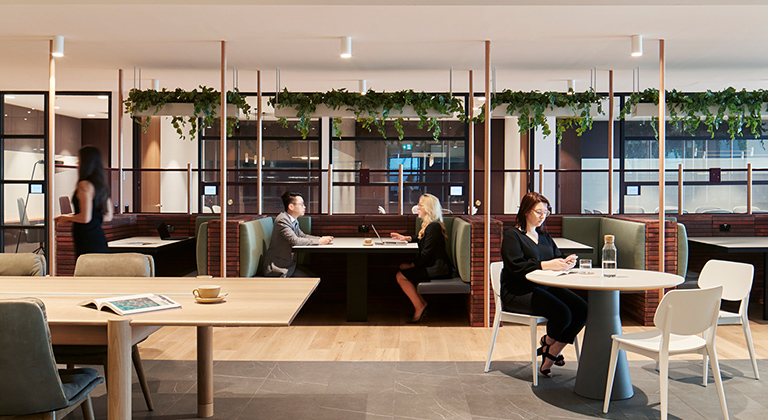
The difference is in spaces designed for how work actually happens today. Flexible workspaces that erase the friction of shifting between focus and collaboration. Smart meeting rooms that let blended sessions run without technical interruptions, delays, or lost participants. Hybrid memberships that give distributed teams a well-supported base—so alignment, planning, and connection can happen wherever they are.
So no, the office isn't a relic. It amplifies work that can't be efficiently replicated online. The future belongs to those who match work type with place, using space intentionally rather than by default.
Productivity Rose, Meaning Didn't Keep Up
On paper, work is more efficient than ever. Tools are faster. Outputs multiply. Bottlenecks shrink. And yet engagement is collapsing.
Global employee engagement fell to 21%, despite years of investment in technology, flexibility, and wellbeing. Lost productivity linked to disengagement costs the global economy an estimated USD 438 billion annually.
This isn't a contradiction. It's a design flaw.
AI removed friction. Virtual offices removed walls. Always-on communication removed silence. What disappeared along the way were the moments where people understand why their work matters.
We didn't lighten work. We accelerated it—and stripped out reflection.
Speed without interpretation doesn't create progress. It creates disorientation. This is why people can be both productive and exhausted, efficient and oddly disengaged.
Work now moves faster than meaning can catch up.
The Skills Conversation Is Missing the Point
We talk endlessly about the skills gap. It sounds sensible. It's also incomplete.
Yes, skills are changing. The World Economic Forum estimates that around 39% of existing skills may be outdated by 2030. But the deeper issue is not scarcity. It's misuse.
Work is still organised around rigid roles and static job descriptions, while the work itself has become fluid, modular, and situational. People have capabilities that go underutilised because organisations don't know how to compose them.
The result is mutual frustration:
- individuals feel constrained,
- organisations insist talent is hard to find.
Both are correct—and both are symptoms of the same design failure.
The shortage isn't skills. It's coherence.
Beneath All of This Is an Identity Question
Strip away the frameworks and tools, and something more human sits underneath the anxiety about work.
People aren't primarily worried about automation. They're worried about relevance. About losing a clear answer to "what do you do?" About watching the rules change without knowing how to re-anchor their value.
This is why titles are defended long after they stop reflecting reality. Why visibility anxiety has intensified in hybrid environments. Why overwork becomes a signal rather than a necessity.
This isn't resistance to change. It's friction between identity and environment. Organisations that ignore this—focusing only on systems and efficiencies—will struggle to maintain trust, even if performance holds in the short term.
What Actually Needs to Change
Not everything. Just the right things.
- Stop treating AI as transformation. It's infrastructure. The real work is deciding what should exist at all.
- Align place with purpose. Offices and digital tools are complementary. Use each intentionally to amplify what they do best.
- Design work around outcomes. Not to erase expertise, but to let capability surface where it's most useful.
- Build pauses back into speed. Judgement still requires space.
- Reward clarity and transferability. Work that clarifies, moves decisions forward, or enables others has disproportionate impact.
- Go flex. Don't bend your work to the room—choose spaces that bend to you.
A Final Thought
The future of work won't be shaped by those who adopt the most tools or speak most confidently about innovation. It will belong to those who noticed what quietly stopped making sense—and had the discipline to redesign around that truth.
In 2026, the question won't be whether work changed. It will be who understood where it changed—and who mistook motion for progress.
Most won't. That, quietly, is where the advantage lies.


