
Article
Virtual Office in Singapore: Do You Need an Office to Have a Singapore Address?

There is a particular moment in most international expansions when the spreadsheet stops being reassuring. The market sizing looks solid, the regulatory research is done, the first client conversations are promising.
Then someone asks the practical question: where, exactly, will the company be based.
For a business testing Singapore rather than committing to it, that question used to have an expensive answer. A lease. A fit-out. A years-long liability on the balance sheet before a single local invoice had been issued. Some companies signed anyway, betting on their own optimism. Many more simply delayed the market entirely, which is its own kind of cost: the competitor who moved first, the client who assumed you weren't serious about the region because you had no local address to put on an invoice.
The businesses that get this right today don't treat it as a binary choice between renting an office and having no presence at all. They've noticed something Singapore's own commercial landscape has quietly confirmed over the past decade: a registered address, mail handling, and access to real meeting space can do most of the credibility work a company needs, long before it needs desks.
Why Singapore Still Earns the Premium
It would be easy to write a paragraph here about efficient government services and low corporate tax, and it would be true, and it would also miss the actual reason sophisticated operators keep choosing Singapore as a regional base rather than, say, running APAC out of a spreadsheet in London.
Singapore functions as a credibility instrument. A Hong Kong-based fund, a Jakarta-based logistics operator, and a Sydney-based SaaS company all use it for slightly different reasons, but the underlying logic is the same: Singapore is the jurisdiction where regional counterparties, banks, and regulators already trust the paperwork.
A company that can put "Singapore" on its letterhead is telling every partner in the region that it has cleared a bar those partners already respect, without having to explain why. That's a genuinely rare property in international business. Most addresses tell you where a company sits. A Singapore address tells other businesses something about how the company was vetted.
This is also why the cheapest possible version of a Singapore address is often the wrong purchase. A mailbox in an unremarkable postal district technically satisfies ACRA's requirements. It does not do any of the reputational work described above, because the people evaluating your business, quietly and without telling you, are checking the address as much as they're checking your pitch deck.
What a Virtual Office Address in Singapore Actually Gives You
A virtual office address in Singapore provides a business with a registered corporate address, professional mail and courier handling, and access to meeting or workplace facilities, without the cost or commitment of a dedicated office lease.
That's the mechanical definition. The more useful way to think about it is as a company's first real foothold in a market it hasn't fully committed to yet. Each element does a specific job.
The Address
This is what appears on your ACRA filings, your invoices, your website footer, and the first line a prospective client reads when they're checking whether you're a real operation or a website with a Stripe account behind it.
Mail and Correspondence Handling
A compliance letter from a bank or regulator doesn't sit unopened in a mailbox nobody checks. Someone flags it, forwards it, and makes sure it gets a response before a deadline passes.
Meeting and Workplace Access
A founder who has spent eighteen months running a company from a laptop in three time zones still needs, occasionally, a proper room with a door that closes, for the client call that shouldn't have a barista steaming milk in the background.
None of this replaces a team. It replaces the myth that a team is the only thing that makes a company look serious.

Who Actually Uses a Virtual Office in Singapore
Four kinds of companies show up in this conversation, and it's worth recognising which one you are before deciding what to buy.
- The market-tester. An overseas company entering Singapore before building a local team. They need the registered address, compliance mail handling, and occasional meeting space for due diligence calls, and nothing more, for twelve to eighteen months.
- The independent practitioner. A consultant or advisor who works from wherever the client is, but whose entire business runs on the perception of seniority. A virtual office closes a specific gap here: between "I am extremely good at what I do" and "I look like I run this out of a spare room," which, fairly or not, still affects whether a prospective client signs.
- The validating startup. Already profitable in its home market, using Singapore as a low-risk way to establish an APAC entity before committing capital to headcount. What they're buying is optionality: a real address now, a real office later, if the numbers justify it.
- The distributed team. Already operating across three or four countries, needing one place where the company legally exists on paper, so contracts, banking, and regulatory correspondence have somewhere unambiguous to land.
If none of these describe your situation, a virtual office probably isn't the right instrument, and it's worth saying that plainly rather than selling around it. A company with fifteen people who need to sit somewhere every day has a workplace problem, not an address problem, and should be looking at coworking or a private office instead.
The Difference Between Having an Address and Having a Presence
This is where most guides to virtual offices stop short, because it's the part that isn't flattering to the cheapest providers.
An address is a fact. A presence is a perception, built cumulatively, out of things a client or regulator notices without being told to notice them: the building the address sits in, whether a real person answers the phone or a call goes to voicemail with a generic greeting, whether there's an actual room to offer when a client asks to meet in person, in the same building as the registered address, or whether the answer is an apologetic pause followed by a coffee shop suggestion.
A mail-forwarding service in a nondescript business park can be the right choice for a company that genuinely needs nothing more than compliance. But a company using its Singapore presence to win larger regional clients is, whether it admits this to itself or not, buying reputation as much as infrastructure.
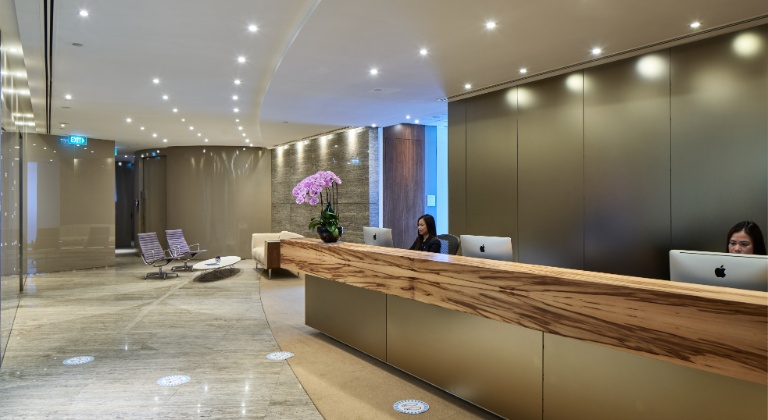
The building matters. An address inside a recognised tower like the Marina Bay Financial Centre or One Raffles Quay carries different weight in a due diligence conversation than an address a client has to look up to confirm exists. That isn't superficial. It's how trust gets built between organisations that haven't worked together yet: through a hundred small, unstated signals, of which the address is one of the first a counterparty checks.
Choosing the Right Virtual Office Address in Singapore
The useful questions to ask a provider are rarely the ones featured on their pricing page:
- Does the address sit in a location a client would recognise or respect, or does it exist purely to satisfy a compliance checkbox?
- Is meeting room access actually included, or is it an add-on that turns a competitive quote into an expensive one the first time you need to use it?
- If a courier arrives with something time-sensitive, is there a person who signs for it and flags it, or does it sit in a pile until someone checks?
- If the business grows and needs a dedicated desk, a private office, or a full regional headquarters in eighteen months, does this provider have anywhere to grow into, or does the relationship end at the mailbox?
That last question separates two categories of virtual office arrangements that get marketed identically but function very differently. One is a standalone administrative service with no further relationship to the business. The other is the entry point into a workplace ecosystem, where the same provider can offer a hot desk next quarter, a private office next year, and a footprint across other regional cities if the Singapore entity turns out to be the first of several.
Virtual Office or Serviced Office: Which One Actually Fits
The honest answer depends on how many people need to be in a room on a given Tuesday.
A virtual office makes sense when the business needs legal and reputational presence but the team is small, distributed, or not yet based in Singapore at all. It's the right tool for compliance, correspondence, and the occasional client meeting.
A serviced or managed office becomes the right call once a company has people who need somewhere to work most days, even if that number is three or four rather than thirty. At that point, the calculation changes: the cost of a dedicated desk or small private office starts to compete with, rather than dramatically exceed, the administrative overhead of maintaining a virtual arrangement plus ad hoc coworking access every time the team needs to meet.
Companies get this wrong in both directions. Some rent office space for a market they haven't validated yet, carrying a fixed cost against uncertain revenue. Others stay on a virtual arrangement long after they've hired a five-person Singapore team, running meetings out of borrowed rooms and public cafes because switching felt like an unnecessary admin exercise. Neither mistake is really about money. Both are about not revisiting the decision once the business has changed.
What a Virtual Office in Singapore Costs, and What Explains the Range
In practice, a virtual office in Singapore typically runs from around SGD 20 up to SGD 200 or more a month, and the gap between those figures maps onto what's actually included, not just brand markup.
The lowest-cost options typically strip out everything except the bare legal minimum: an address for ACRA registration and basic mail forwarding, no meeting room access, no reception service, often in a building chosen for cost rather than location. That can be a completely rational choice for a company whose only requirement is technical compliance.
Higher-tier arrangements price in the things that actually build a presence: a recognised business address, professional call and mail handling, included meeting room hours, and access to a broader workplace network if the business needs to host a client in Sydney or Hong Kong the following month. The gap in price between these tiers is really a gap in what the company is buying: one is buying a compliance requirement, the other is buying a piece of the impression it makes on everyone who checks.
The right frame isn't "which is cheapest" but "cheapest for what." A company using the address purely for a dormant holding entity has different needs to one actively selling into the Singapore market and expecting counterparties to visit.

Why Businesses Choose The Executive Centre in Singapore
The Executive Centre's Virtual Offices are built around a simple idea: a business address should be more than a line on a document. It should be a place a company can confidently welcome clients, partners, and teams when the moment calls for it.
TEC’s Singapore locations are situated in Grade A buildings across the central business district, giving businesses a professional presence in some of the city’s most recognised commercial addresses. Beyond the address itself, Members benefit from professional call handling in local languages, same-day mail management and forwarding, complimentary monthly coworking hours, preferential Member rates on Meeting Rooms and workspace, as well as access to TEC Community events and exclusive Member benefits across the global TEC network.
The value often appears in the moments that cannot be planned. A regulatory document requires prompt attention. A client requests an in-person meeting with little notice. A visiting executive needs a private room for a confidential conversation. Instead of finding a workaround, businesses have a professional environment ready when they need it.
A Virtual Office with TEC is also designed to support what comes next. As a company grows, it can transition from a Business Address to a Dedicated Desk or Private Office while remaining within the same workplace ecosystem, supported by the same team and network.
For businesses entering Singapore, that flexibility means establishing a presence today while keeping the option to evolve as needs change.
Speak with The Executive Centre’s Singapore team to explore the right setup for your business.
Frequently asked questions
A virtual office provides businesses with a professional business address and services such as mail handling and correspondence management, without requiring them to lease a dedicated office. Depending on the provider and package, additional services such as call handling, meeting room access, or flexible workspace may also be available. For many companies, it offers a flexible way to establish a presence in a new market without committing to a full office lease.
Yes. A company incorporated in Singapore must have a registered office address, but it does not need to lease a traditional office. A virtual office that meets ACRA’s requirements can be used as the company’s registered office while providing additional services such as mail handling and business support.
For overseas businesses, a virtual office can be a practical first step. It provides a registered address, helps establish a local business presence, and allows companies to test the Singapore market before committing to permanent office space or building a local team.
A virtual office is ideal when a business needs a professional presence but not a permanent workplace. It allows companies to manage official correspondence, maintain a business address and meet clients professionally, while avoiding the cost and long-term commitment of a traditional office lease.
Virtual office pricing varies depending on the provider, location and services included. Address-only services can start from around SGD 20 per month, while more comprehensive solutions with professional call handling, meeting room access and workplace benefits can range from SGD 100 to SGD 200+ per month. Rather than comparing prices alone, businesses should consider what level of service, support and flexibility are included.
The Executive Centre’s Virtual Office includes a prestigious Business Address in a Grade A building within Singapore’s central business district, professional call handling in local languages, and same-day mail forwarding. Members also enjoy complimentary monthly coworking hours, preferential Member rates on Meeting Rooms and workspace, invitations to TEC Community events, and exclusive Member benefits and partner privileges across the global TEC network. The service is ready to use immediately, with no lengthy onboarding or office lease required.


