
Article
Cost of Running a Company in Hong Kong in 2026: A First-Year Guide

Hong Kong rewards speed. You can form a company in days. You can be working from Central within a week. Yet the founders who thrive here share one trait: they treat incorporation as a receipt, not a result.
The result arrives later, in a quiet stack of duties. A register here. A certificate there. A renewal date that slips past while you chase revenue. Miss one and the penalty can dwarf the fee you tried to save.
So, what does a Hong Kong company really cost after incorporation?
For a simple, active private company without a conventional office lease, a sensible first-year planning estimate is approximately HKD 20,000 to HKD 40,000.
That is not an official government total. It is an estimate based on current government fees and published provider prices. A dormant company may cost less. A trading company with employees, inventory, payroll or complex cross-border activity can cost considerably more.
This piece covers that stack. Not how you form. What you owe once you exist.
The Certificate on the Wall Matters More Than the Plaque on the Door
What is post-incorporation compliance in Hong Kong?
Post-incorporation compliance is the set of ongoing duties that keep a Hong Kong company properly maintained: a valid Business Registration Certificate, statutory records, a Significant Controllers Register, a company secretary and a registered office in Hong Kong.
The Inland Revenue Department requires companies incorporated under the Companies Ordinance to register their business. The Companies Registry sets out the requirements for a company secretary, registered office and current company particulars.
The first cost is not usually the largest. The expensive part is allowing small obligations to become late filings, rushed professional work or avoidable penalties.
Hong Kong gives you a relatively light tax regime and a demanding paper regime. Respect the paper and the city gives you something valuable in return: a company that looks ready for business.
Day 1 to 30: Four Duties to Put in Place
1. Display Your Business Registration Certificate
A valid Business Registration Certificate must be displayed in a conspicuous place at the address where the business is carried on.
The IRD’s certificate-display guidance also states that the certificate must be produced for inspection when required.
If you are using a virtual office or serviced address, confirm how this works before signing. Ask where the certificate is displayed, who receives official visitors and how the provider handles an inspection.
2. Keep Your Significant Controllers Register
Most unlisted Hong Kong companies must identify their significant controllers and maintain a Significant Controllers Register.
The register is not an annual filing. It is a company record that must be kept at the registered office or another prescribed place in Hong Kong and made available for inspection when required.
The Companies Registry’s SCR guideline explains the requirement in detail.
The register must also include the contact details of a designated representative. That person may be a Hong Kong resident shareholder, director or employee, or a qualified accounting professional, legal professional or licensed trust or company service provider. The Companies Registry’s SCR pamphlet sets out the permitted categories.
This work may be included in a company secretary package. It may also be charged separately.
3. Confirm Your Company Secretary and Statutory Records
A Hong Kong private company must have a company secretary. An individual secretary should ordinarily reside in Hong Kong. A corporate secretary must have its registered or principal office in Hong Kong.
The sole director cannot also act as the company secretary.
If your formation agent provided a secretary during incorporation, confirm what happens next. Does the appointment continue for the year? Does the fee include the annual return? Who maintains the statutory registers? Who acts as the designated representative?
The Companies Registry’s incorporation guidance provides the statutory framework. The price is commercial and varies according to the work included.
4. Test Your Registered Office
Every company must maintain a registered office in Hong Kong. It is the address to which official communications and legal notices may be sent.
The registered office is not necessarily the place where you work every day. It is also not the same thing as a full operating office.
Send a letter to the address in week one. Check how quickly it is received, who alerts you and how documents are stored. If the answer is vague, the service is not ready for a company that depends on timely notices.

Day 30 to 90: The Costs That Surprise Founders
Incorporation quotes look tidy. Year-one reality has more lines.
Business Registration
The Business Registration Certificate is renewed annually.
For certificates commencing between 1st April 2026 and 31st March 2027, the IRD’s current fee table lists:
- Business Registration fee: HKD 2,200;
- levy: HKD 150;
- total: HKD 2,350 for one year.
That is the current figure for this fee period, not a permanent annual price. The charge may already have been collected when the company was formed, but it remains part of the first-year budget.
Annual Return
A local private company must file an annual return within 42 days after each incorporation anniversary.
The current on-time annual registration fee is HKD 105, according to the Companies Registry’s private company guidance.
Late fees rise sharply, reaching HKD 3,480 for a return delivered more than nine months late.
The Business Registration charge and on-time annual return therefore create a basic government-fee reserve of HKD 2,455. The two payments do not necessarily fall within the first 90 days, but they belong in the first-year budget.
Company Secretary
Published provider prices offer a useful marker, but not a universal market rate.
Sleek’s company secretary pricing guide lists a standard single-shareholder package from HKD 1,300 per year and a premium package from HKD 3,800 per year.
Check what sits inside the fee. A basic package may not include share transfers, director changes, meeting support, designated representative services or additional filings.
Audit and Tax
Active companies should reserve for audit and Profits Tax work early. Do not assume that a company with little revenue has no compliance cost.
The Companies Registry confirms that companies generally remain subject to audit, even where they qualify for simplified reporting. The main exception is a company that has formally become dormant. The relevant accounts and audit guidance explains the position.
There is no official audit tariff. As one published commercial marker, PAT CPA lists small-business audit fees of approximately HKD 7,000 to HKD 17,000, depending on the company’s size and complexity.
Sleek publishes combined statutory audit and Profits Tax filing from HKD 5,500 per year.
These figures should not be added together. They cover different scopes. One provider may quote audit only, while another may include tax filing and related compliance work.
Bookkeeping
Bookkeeping is another variable.
Sleek estimates basic annual accounting compliance at approximately HKD 3,000 to HKD 6,000. PAT CPA’s published accounting packages provide another reference point, with plans starting from HKD 1,000 per month for certain small businesses.
A company with no transactions may need limited bookkeeping. A business receiving payments, paying suppliers and operating across several jurisdictions may need monthly support from the first invoice.
Address and Presence
A registered office fulfils a legal requirement. It does not give a company somewhere to work, meet clients or base a team. A full-time lease can cover all three, but it also makes the business pay for space every day.
At The Executive Centre (TEC), the choice is not office or no office. It is how much presence the business needs, and for how long. Prime locations, polished surroundings and first-class service matter when clients walk through the door. The table below sets out what each option is designed to do.
| Workspace Option | What It Is Really For | What You Get | Starting Price |
|---|---|---|---|
| Virtual Office | Establishing a presence without taking a lease | A prime business address, call and mail handling, plus complimentary monthly Coworking Space access | From HKD 585 per month |
| Day Pass | A desk without a commitment | On-demand access to premium Coworking Space and its facilities | From HKD 700 per person |
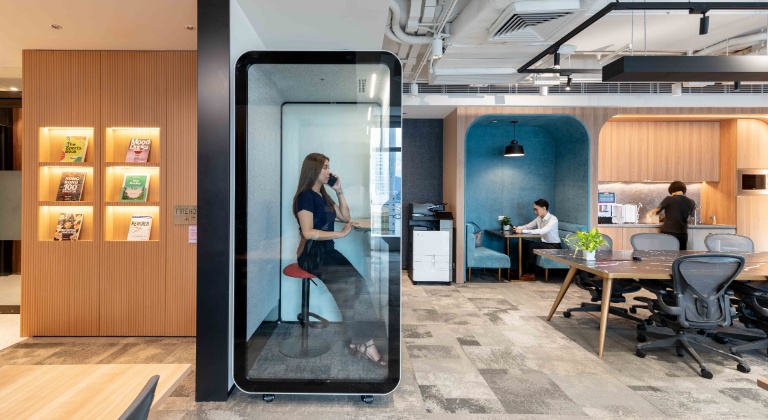
| Coworking Space | Regular workdays without an office lease | Choose a City Pass, Global Pass or Dedicated Desk, with Wi-Fi, refreshments, Phone Booths, business support and Meeting Room access | From HKD 3,600 per month |
| Day Office | Privacy without permanence | A secure, lockable Private Office for 10 days a month or unlimited use | From HKD 4,500 per person per month |
| Meeting Rooms | Putting clients in the right room | Hourly or daily bookings, high-speed connectivity, audio-visual technology and on-site support | From HKD 380 per hour |
| Private Office | Giving a team a proper base | A furnished, lockable office with 24-hour access, IT infrastructure, reception and administrative support | Price on enquiry |
| Managed Office | Building the office around the business | TEC handles the location, design, fit-out and day-to-day operations, with costs structured into one monthly fee | Bespoke quotation |
What It Costs in Year One
No honest article gives one universal total. The company’s activity, ownership, address and service scope all change the answer.
For planning purposes:
A lean active company may come in at approximately HKD 20,000. That could combine the HKD 2,455 government-fee reserve, a basic secretary package, a published audit and tax starting price, and a basic business address. It may not include bookkeeping or additional filings.
A properly supported small company may cost approximately HKD 23,000 to HKD 42,000. That model allows for a broader secretary package, audit, bookkeeping and a more substantial address service.
A trading or growing company can exceed HKD 40,000. Employees, payroll, inventory, cross-border transactions, tax advice and complex accounts move the budget quickly.
These are planning estimates assembled from published prices. They are not quotes, and individual services may overlap. Ask each provider what is included before comparing totals.
The point is not thrift. It is allocation. Every dollar you avoid locking into fixed rent is a dollar available for product, hiring or pipeline.
Is a Dormant Company Cheaper?
Usually, yes, but “no revenue” does not automatically mean “dormant”.
A company becomes dormant through the statutory process explained in the Companies Registry’s dormant company guidance.
A dormant company may avoid the audit requirement and, during the relevant period, the annual return requirement. It must still maintain its registered office, company secretary and required company records. Changes to directors, secretaries or the registered office must still be reported.
A company that has simply not invoiced anyone may still have accounting transactions and may not qualify as dormant.
What This Estimate Does Not Include
The HKD 20,000 to HKD 40,000 planning range does not include:
- conventional office rent;
- deposits or fit-out;
- employees and payroll;
- immigration or employment visas;
- licences and permits;
- insurance;
- inventory;
- banking charges;
- payment processing;
- complex tax planning;
- legal agreements;
- significant changes to the company structure.
These costs can easily outweigh the company’s basic compliance budget.
The Company Starts After Incorporation
Formation gets the company onto the register. From there, the right setup is proportionate: enough support to keep things moving, enough flexibility to change course and no unnecessary weight to carry.
Looking for a Hong Kong base that fits the business now, without boxing it in later? Explore TEC’s flexible workspace options.
Frequently asked questions
No. A local company must have a registered office in Hong Kong, but it does not need a conventional leased office simply to operate. The registered office is for statutory correspondence. Where the team works is a separate business decision.
A company might work remotely, use a virtual office for its address, book meeting rooms when clients visit or take workspace only when its working pattern justifies it.
Sometimes, depending on the provider, service and compliance terms. A virtual office may provide a business address without including registered-office services.
Before signing up, confirm that the selected plan explicitly covers registered-office use, official correspondence and statutory notices. Also check that the provider is licensed to offer the relevant company services. The paperwork needs the right service, not just the right postcode.
Compare the scope, not just the headline price. Check whether the quote includes the annual return, statutory records, Significant Controllers Register administration, designated representative, registered office, mail handling, audit, Profits Tax filing, bookkeeping and additional filings.
Then ask what triggers a separate fee, whether government charges are included and whether the price assumes a 12-month commitment. A low quote may simply be a shorter list.
At The Executive Centre, TEC’s Virtual Office range covers more than a mailing address. Depending on the plan and Centre, it can include a Business Address, mail and parcel notifications, complimentary Coworking Space hours, Call Handling, voicemail, professional guest reception and Member rates for Meeting Rooms.
The Business Address option starts from HKD 585 per month, while the Premium Package starts from HKD 1,080 per month. Prices vary by Centre and term, and published rates may reflect discounted 12-month commitments.
Yes. TEC Meeting Rooms are available to Members and non-Members and can be booked by the hour or day.
Rooms include high-speed connectivity, audio-visual technology and on-site support. It is a useful option when the team works remotely but the meeting needs more than a laptop, a coffee shop and optimism.
Choose TEC Coworking Space when you need a professional place to work and are comfortable using shared areas. Choose a TEC Day Office when you need a lockable, private room for confidential calls, focused work or a client-facing day.
At TEC, Day Office plans provide access to a Private Office for any 10 days each month or on an unlimited basis, subject to availability.
A TEC Private Office is a furnished, lockable workspace for a team that wants a ready-to-use base, with IT infrastructure, reception and operational support already in place.
A TEC Managed Office is designed around a more specific brief. TEC manages the location, design, fit-out and day-to-day operation, with costs structured into one monthly fee. In short, a Private Office gives you a ready base. A Managed Office gives you a workplace built around the organisation.
Yes, subject to availability and the terms of the new product. A company might begin with a TEC Virtual Office, add TEC Coworking Space for regular workdays and use TEC Meeting Rooms when clients visit. A TEC Private Office becomes more relevant when the team needs consistent privacy, storage and a reliable base.


