
Article
Starting a Family Office in Singapore: What the 2026 Rules Require

Singapore has crossed the 2,000-family-office mark. That is a milestone, but it also changes the mood around the sector.
The city is no longer asking only who wants to come. It is asking what will happen once they do.
As of 31st December 2025, more than 2,000 Single Family Offices received tax incentives in Singapore, according to MAS’s Parliamentary reply of 5th August 2026. The number reflects Singapore’s success in attracting family capital from across Asia and beyond. It also explains why the next phase is less about welcome mats and more about expectations.
A family office setting up in Singapore in 2026 needs more than an incorporation certificate and an impressive address. It needs the right people, a genuine operating budget and a credible connection to the local investment ecosystem.
For principals, the question is no longer simply whether Singapore is a good place to establish a family office.
It is whether the proposed office is built to operate there properly.
Singapore Has Changed the Question
On 15th June 2026, the Monetary Authority of Singapore introduced a revised licensing-exemption framework for Single Family Offices.
The framework creates a clearer route for qualifying SFOs to operate without a fund-management licence. It also brings more structure to how an SFO begins operating and reports its activities.
A new SFO must generally:
- Be incorporated in Singapore.
- Manage assets for eligible family-related parties.
- Maintain the required bank accounts.
- Notify MAS when operations begin.
- Submit annual returns.
The Notice of Commencement of Business must be filed within 14 days of the SFO beginning operations. Existing SFOs have until 15th June 2027 to comply with the revised framework, according to MAS’s licensing-exemption FAQs.
This is one part of the picture.
The other is Singapore’s tax-incentive framework under Sections 13O, 13OA and 13U. Those schemes add requirements around Designated Investments, investment professionals, local spending and capital deployment.
In other words, establishing a family office in Singapore involves two related decisions:
- Can the SFO operate under the licensing exemption?
- Can its fund vehicle meet the conditions for tax incentives?
The office, team and investment plan need to be designed with both questions in mind.

13O or 13U? Start With the Real AUM
The choice between Section 13O and Section 13U is often treated as a tax decision. In practice, it also determines the size of the required investment team and the scale of the local operating model.
| Requirement | Section 13O / 13OA | Section 13U |
|---|---|---|
| Minimum Designated Investments | SGD 20 million | SGD 50 million |
| Qualifying investment professionals | Two | Three |
| Non-family investment professionals | At least one | At least one |
| Singapore tax resident professionals | Required | Required |
| Local spending | Tiered according to AUM | Tiered according to AUM |
| Capital deployment | Lower of 10% of AUM or SGD 10 million | Same |
These are the current criteria set out in MAS’s Fund Tax Schemes for Family Offices.
The SGD 20 million and SGD 50 million thresholds refer to Designated Investments, not necessarily the family’s total wealth.
That distinction matters. A family may have considerable wealth tied up in operating businesses, property or other assets, but the relevant scheme looks at the qualifying investment base.
The same principle applies to the team. The right question is not how few people the office can appoint. It is what the mandate genuinely requires, and whether those people meet the scheme’s criteria.
The Three Things Singapore Wants to See
The requirements are easier to understand when reduced to three practical questions.
Who is Doing the Investment Work?
A Section 13O or 13OA structure requires two qualifying investment professionals. A Section 13U structure requires three.
At least one must be a non-family professional.
Qualifying investment professionals must be Singapore tax residents, earn more than SGD 3,500 per month and spend more than 50% of their working time on qualifying activities such as portfolio management, research analysis or trading.
A lean team is possible. An imaginary one is not.
The people named in the structure should have clear responsibilities and a meaningful role in the investment process. Someone should be able to explain who researches opportunities, who makes decisions, who monitors risk and who reports to the family.
What Activity Happens in Singapore?
The minimum local spending requirement depends on the fund’s Designated Investments.
| AUM in Designated Investments | Minimum local spending |
|---|---|
| Below SGD 250 million | SGD 200,000 |
| SGD 250 million to below SGD 2 billion | SGD 500,000 |
| SGD 2 billion or more | SGD 1 million |
The relevant rules also set minimum local business-spending components and specify which donations or grants may count.
The important point is that local spending should reflect a real operating business. Payroll, professional services, accounting, legal advice, technology, administration and office costs may all form part of that picture, subject to the applicable rules.
An address can tell people where the company is registered. It cannot, on its own, tell them where the work is happening.
How Is the Portfolio Connected to Singapore?
The capital deployment requirement is the lower of:
- 10% of AUM in Designated Investments; or
- SGD 10 million.
Qualifying investments may include securities listed on approved exchanges, certain investments distributed by MAS-licensed financial institutions in Singapore and investments in Singapore-incorporated companies with operating businesses and a substantive presence.
The family office does not need to abandon a global investment strategy. It does need to understand how the Singapore-linked portion of the portfolio will be built and maintained.
The address, the team and the portfolio should not tell three different stories.
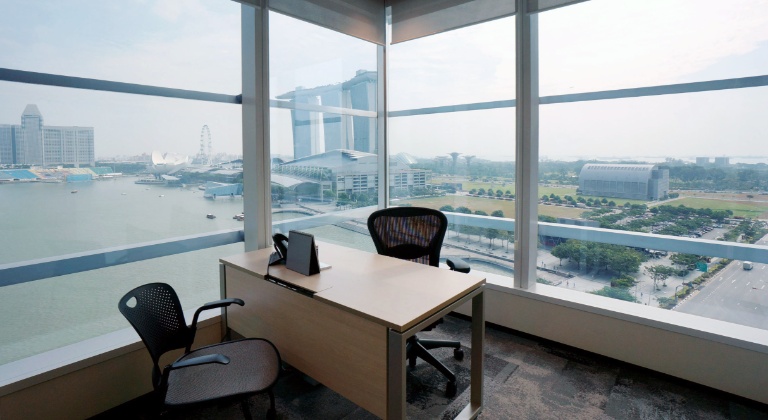
Where Does a Lean Family Office Team Work?
A small family office investment team does not necessarily need a large conventional office. It does need somewhere private enough for confidential work and considered enough for serious conversations.
That is increasingly relevant in Singapore’s office market. Core CBD Grade A rents reached SGD 12.75 per sq ft per month in Q3 2026, while vacancy fell to 2.6%, according to CBRE’s Singapore Figures for Q3 2026.
For a two to four-person team, the question is not how much space it can take. It is what the space needs to do.
The office should provide:
- A private room for confidential investment work.
- Secure access and dependable connectivity.
- A credible setting for meetings with banks, advisers and investment managers.
- Reception, mail and visitor support.
- Meeting rooms for larger discussions.
- Flexibility to add space as the team develops.
The Executive Centre’s Private Offices in Singapore are located in established business districts including Marina Bay and Raffles Place. They offer dedicated workspaces, around-the-clock keyless access, enterprise-grade IT infrastructure, visitor reception, mail handling and on-site support.
For a new family office, that creates a proper operating base without requiring the team to take a large conventional floor before it needs one. Additional Private Offices in Singapore.
Frequently asked questions
Not necessarily. A qualifying single family office may operate under MAS’s licensing-exemption framework if it meets the relevant conditions, maintains the required bank accounts and files its notification with MAS.
An SFO that does not qualify may need a fund-management licence or specific regulatory advice.
A Single Family Office manages wealth for one family and eligible related parties. A multi-family office manages assets or provides services for multiple families.
The two models have different operating and regulatory considerations. A business serving several unrelated families should not assume that the SFO licensing exemption applies to it.
A qualifying investment professional must generally be a Singapore tax resident, earn more than SGD 3,500 per month and spend more than 50% of their working time on qualifying activities such as portfolio management, research analysis or trading.
Yes. A Singapore family office can hold international investments. However, a fund using the 13O, 13OA or 13U tax incentives must also meet the relevant capital deployment requirement for qualifying Singapore-linked investments under MAS’s fund tax schemes for family offices.
There is no universal timeline. The process depends on the ownership structure, fund vehicles, banking arrangements, tax-incentive application, recruitment and investment mandate.
The most time-sensitive regulatory requirement is the MAS notification. A new SFO must file its Notice of Commencement of Business within 14 days of starting operations.
Yes. A serviced office can provide a dedicated workplace, secure access, business infrastructure and meeting rooms for a small investment team.
It does not replace the requirements relating to qualifying professionals, local spending, banking or capital deployment.
A private office is a dedicated workspace for an active team. It suits investment professionals who need privacy, secure access, reliable connectivity and space for confidential meetings.
A virtual office is primarily an address and administrative solution. Depending on the provider and agreement, it may support mail handling or registered-address requirements. It is not a substitute for a functioning local office.
The Executive Centre has Private Offices in established business districts across Singapore, including Marina Bay, Raffles Place, Beach Road and Church Street. Locations include Capital Square, Frasers Tower, The Gateway West, Marina Bay Financial Centre Tower 1, Ocean Financial Centre, One Raffles Quay, Six Battery Road, Singapore Land Tower, The Exchange by Singapore Land Group and IOI Central Boulevard Towers.
Yes. TEC Meeting Rooms can be used for discussions with investment managers, advisers, banks and family members. They provide additional space when a Private Office is not large enough for the meeting.
Yes. The appropriate workspace depends on the team size, privacy requirements and meeting schedule. A small team can begin with a dedicated Private Office and review its space requirements as the investment team and mandate develops.


